
Dermaplaning Training UK: Your Complete Certification Guide 2026

Dermaplaning has earned its place as one of the most popular facial treatments in the UK. Clients love the immediate results - smoother skin, a brighter complexion and the kind of glow that makes them book again six weeks later without needing much prompting. For practitioners, it is a treatment that is relatively straightforward to learn, genuinely enjoyable to deliver and commercially rewarding from the first week of practice.
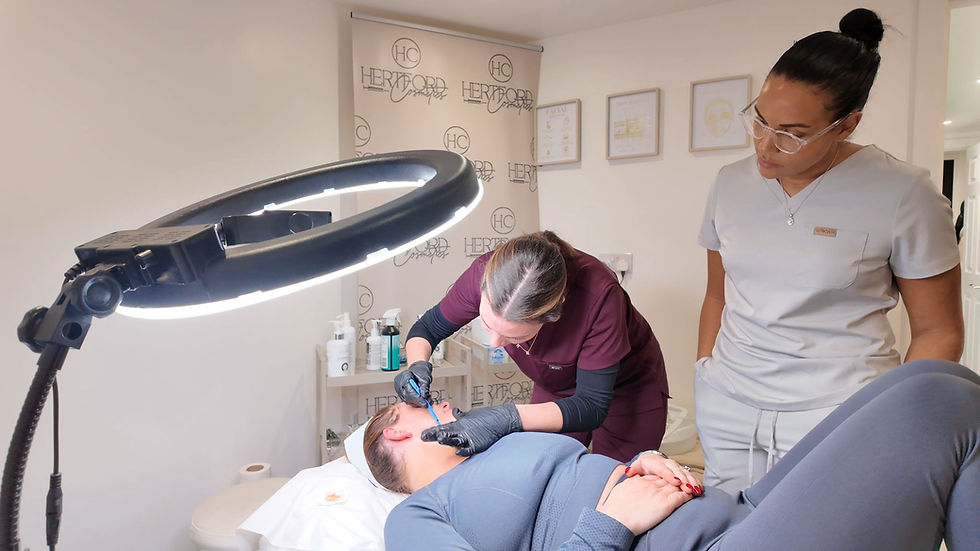
If you are considering dermaplaning training UK, this guide covers everything you need to make a confident, informed decision - from what the training actually involves and what legal requirements apply, through to costs, income potential and how to choose a course that gets you insured and client-ready.
What Is Dermaplaning and Why Get Trained?
Dermaplaning is a physical exfoliation treatment that uses a sterile, surgical-grade blade to remove the outermost layer of dead skin cells and vellus hair from the face. The blade is held at a precise 45-degree angle and drawn across the skin in short, controlled strokes.
The results are immediately visible. Skin looks smoother, brighter and more even-toned. Makeup application improves dramatically. Skincare products penetrate more effectively because the barrier of dead cells has been removed. Clients see the difference the same day - which is why the treatment books so reliably.

Professional dermaplaning is fundamentally different from at-home tools sold online. Professional practitioners use surgical-grade, single-use blades with clinical precision, achieving a depth of exfoliation that consumer tools simply cannot match.
For practitioners, dermaplaning represents an ideal entry point into aesthetics. It does not require medical training. Equipment costs are low. Appointment slots are relatively quick. And the repeat booking rate is outstanding - most clients return every 4-6 weeks.
Dermaplaning Training UK: Legal Requirements
Dermaplaning currently sits outside the scope of prescription-only procedures in the UK, which means it is not restricted to medical professionals. Trained beauty therapists, aestheticians and practitioners without clinical backgrounds can offer it legally - provided they hold appropriate training and insurance.
Insurance is the critical compliance requirement. Most UK insurers will only provide professional indemnity cover for dermaplaning if you hold a CPD-accredited qualification. A certificate from a non-accredited course is typically rejected at the point of insuring.
Local authority registration may apply depending on your council's licensing framework. Some authorities classify dermaplaning as a licensable treatment due to the use of a blade on the skin. Always check with your local environmental health team before treating clients commercially.
Blade disposal carries its own obligations. Dermaplaning blades are classified as sharps and must be placed in an approved sharps container immediately after use and collected by a licensed clinical waste contractor.
What Does Dermaplaning Training Cover?
Good dermaplaning training UK covers considerably more than how to hold the blade. The theory component is what equips you to make sound clinical decisions - including knowing when not to treat.
Skin anatomy is the foundation. Understanding the layers of the skin, how the epidermis functions and what happens physiologically during and after dermaplaning allows you to adapt your technique intelligently.
Contraindications are covered in depth. Active acne, rosacea, eczema, psoriasis, recent waxing, recent chemical peels and certain skincare actives all require consideration. A practitioner who cannot assess contraindications confidently should not be treating clients.
The practical element covers blade angle and pressure technique - the two factors that most influence both safety and results. Developing a feel for the treatment takes practice on live models, which is why genuinely hands-on training matters so much.
Dermaplaning Training UK: Course Options
The most common format for dermaplaning training in the UK is a one-day intensive course combining theory and practical training in a single session. Our CPD-accredited dermaplaning course at Hertford Cosmetics Academy follows this format - you leave with your certificate and genuine hands-on experience the same day.

Split-format courses where online theory precedes an in-person practical day are also available. These can work well if you prefer to absorb the theory at your own pace, though the quality of the online theory material varies considerably between providers.
For practitioners who want a broader foundation in skin treatments, our Skin Care Specialist course covers dermaplaning alongside chemical peels and other skin treatments within a single comprehensive qualification - an excellent option if you are building a skin treatment menu from scratch.
Dermaplaning Certification and CPD Accreditation
CPD accreditation is the industry benchmark for aesthetics training quality in the UK. It means an independent body has reviewed and approved the course content, delivery method and assessment process against a recognised standard.
Most UK aesthetics insurance providers require CPD-accredited training as a minimum condition of cover. Without it, you cannot get insured. Without insurance, you cannot treat clients commercially.

Verifying accreditation before booking is simple but important. Ask the training provider for the name of their accrediting body and the course registration number. Then visit the accrediting body's website and confirm that both the provider and the specific course are listed.
Dermaplaning Training Costs UK
Foundation dermaplaning training in the UK typically costs between £200 and £500. A course at £200 that skips genuine hands-on practice and cannot verify its CPD accreditation is not cheaper than a £400 course that delivers both - it is more expensive in the long run.
Equipment costs after qualifying are genuinely low. Single-use blades cost pennies each at professional wholesale prices. A dermaplaning wand or handle costs £20-£60.
At £40-£80 per standalone dermaplaning session (£80-£150 combined with other treatments), the return on your training investment is rapid. Most practitioners cover their full course cost within the first five to ten client appointments.
Dermaplaning Career and Income Potential
Dermaplaning is an excellent income contributor precisely because of its combination of repeat booking rate, quick appointment time and low running costs.

A standalone dermaplaning appointment takes 30-45 minutes. Booking six dermaplaning clients in a day at £70 each generates £420 in revenue. Combine this with other skin treatments and the numbers add up quickly.
The treatment pairs naturally with chemical peels and microneedling - offering a package that addresses both immediate texture improvement and longer-term skin health. Many clients who start with dermaplaning progress to booking additional treatments as their trust in the practitioner grows.
Mobile dermaplaning is particularly well-suited to a home-visit model. The equipment is compact and easy to transport, and the flexibility of home visits commands a premium price point in most markets.
Hertford Cosmetics Academy Dermaplaning Course
Our CPD-accredited dermaplaning course at Hertford Cosmetics Academy gives you the theory, technique and hands-on confidence to start treating clients immediately after qualifying.
Delivered at our Widford, Ware, Hertfordshire training location, the course covers skin anatomy and physiology, contraindication assessment, consultation skills, blade angle and pressure technique, infection control, aftercare and client homecare guidance. You practise on live models under direct supervision.
Practitioners looking to continue building their skin treatment menu may also be interested in our Chemical Peels CPD course and Microneedling CPD course - both natural progressions from a dermaplaning foundation.
Key Takeaway
Dermaplaning training UK offers one of the most accessible and commercially rewarding entry points into professional aesthetics. Low equipment costs, high client demand, excellent repeat booking rates and straightforward technique make it an ideal starting treatment.
At Hertford Cosmetics Academy, our CPD-accredited dermaplaning course gives you everything you need to start treating clients with confidence. Explore the course and book your place today.

Frequently Asked Questions
How long does dermaplaning training take?
A foundation dermaplaning course is typically delivered as a one-day intensive covering both theory and practical training.
Do I need existing beauty qualifications to enrol?
Not for most dermaplaning courses. The treatment does not carry prescription restrictions, and reputable providers accept enrolments from practitioners at all experience levels.
Is dermaplaning training difficult?
The fundamental technique is learnable by most people. The theory - particularly contraindications and client assessment - requires genuine study, but nothing beyond the reach of a motivated learner.
Will one CPD course be enough to get insured?
Yes, for dermaplaning specifically. A single CPD-accredited dermaplaning course is generally sufficient to obtain professional indemnity and public liability insurance for this treatment.
Can I offer dermaplaning from a home salon?
In most cases, yes - subject to your local authority's licensing requirements and your insurance policy permitting home-based practice.


_edited_edited.png)

Comments